Showing posts with label dblog week. Show all posts

Sunday, May 17, 2015

Diabetes Blog Week Day Seven: Continuing Connections


The very first inspiration for Diabetes Blog Week was to help connect our blogging community, and that continues to be the most important reason it's held every year.  So let's help foster and continue those connections as we wrap up another Dblog Week.  Share a link to a new blog you've found or a new friend you've made.  Or pick a random blog off of the Participant's List, check it out and share it with us.  Let's take some time today to make new friends. Read all responses here.

The two best reasons to write are for yourself and for others. If you only write for adulation, you never reach truth. If you only write for yourself, you can risk self-indulgence or have your head become an echo chamber. It’s the words that come from you and contain the possibility of connection with others that, at least in my mind, lead to real success and purpose.

I’ve read nearly all the blog posts for this week (I have a little catching up to do from yesterday). Anything that wasn’t on YouTube or in a language that I’m not very good at (anything other than English or French) was read. I think that’s important. If we can read others’ posts, particularly during this week, we should, to increase community solidarity, encourage those who don’t have popular or long-standing blogs, and to broaden our horizons. Even if the experiences resonate a bit less, I think this week is the ideal time to read blogs from people not your “type,” or without your experiences. If you’re Type 1, read blogs from Type 2s, and vice versa. If you have insurance, read blogs from those who aren’t. Read blogs from outside your country, from outside your age group. Pumpers, read MDI blogs. Gluten aficionados, read gluten-free blogs. Low carbers, read carb-loving blogs. It’s great to read blogs that echo our own experience (you are not alone), but it’s also great to remember that YDMV – your diabetes may vary – by seeing how diverse our lives are around the common experiences we have. You might even pick up some tips, or inspiration, from how others lead their lives!

I’d like to thank everyone who commented on my blog this week. I’m great at reading blogs, but have a harder time leaving a lot of comments. This is too bad, because other than the statistics page, without a comment, a writer doesn’t know if his or her writing has had any impact. A nice comment makes my day, and I know it does for others. There are some people, like Kelley, who are absolute commenting rock stars, spreading cheer through the community by finding something to say about seemingly almost everything they read. That’s really lovely, and I really appreciate it.

Here are some posts that had an impact on me this week:

Laddie and I went to the same small undergrad (a few years apart) and while I hope I’ll run into her at Reunions some day, I always love what she has to say at Test, Guess and Go. This week, she inspired me to at some point actually get my vegetable noodle maker (spiralizer) out of its box, where it’s been since I received it at my bridal shower, and do something with it.

Alecia at SurfaceFine wrote two very moving posts: I was left almost speechless at her story of a particularly cruel date, and cheered for her when I read “No Changes”.

I loved the meme and discussion about the must frustrating of words, “controlled,” at T1 and Gluten Free. (Mindy Lahiri says, “Gluten is my favourite food,” and I’m inclined to agree with her, but that doesn’t mean I can’t respect and learn a lot from someone who doesn’t eat it!)

George at Ninjabetic provided me with a great response to a “what’s it supposed to be?” question, re: the number on my meter. “It’s supposed to be I don’t have diabetes!” might be the perfect retort. I almost can’t wait for someone to ask me the previously-irritating question.

You should read all of Heather’s blog, Unexpected Blues, because it’s elegant and lovely.

Finally, Marie’s blog post for “I Can” at Joy Benchmarks is basically the perfect argument for the existence of D-Blog Week: it lets us belong to a community, lets us be accepted, helps our puzzle piece fit with hundreds of others that, for the first time, interlock with our own.

Thank you for letting me be a part of this wonderful community. Thank you for reading, and writing, and just being. Thank you for documenting the ups and downs of the ins and outs of this disease.

They say history is written by the winners. I say those who write history, win. We’re all winners here.

Until next time.

Saturday, May 16, 2015

Diabetes Blog Week 2015 Day Six: Favourites and Motivations

If you have been blogging for a while, what is your favorite sentence or blogpost that you have ever written?  Is it diabetes related or just life related?  If you are a new blogger and don't have a favorite yet, tell us what motivated you to start sharing your story by writing a blog?  (Thank you Laddie of Test Guess and Go for suggesting this topic.)
 

Writing is very important to me. It’s a passion of mine. When I was younger, everyone thought I was going to write the Great Canadian Play. That may never happen, but I love getting to “write what I know” on this blog, and in the process, connect with other people in some way. Here are a few favourite moments, for me, in three categories.


 “Popular”


 My second-most read post of all time was one I almost deleted, because I wrote it in a very emotional space, and I was worried it would be controversial. “Liar” is about all the things, people, and institutions that lie to people with diabetes throughout our lives. It sparked a lot of discussion, was shared by many people and organizations, and even made it to a conference slide (which I found out about after it was posted on the Internet; it would have been nice to be informed or asked, thanks).


 So when I hear that test strips can be +/- 20% in accuracy (a 10 could be 12, or 8) and are often worse, it makes me sad. Because it's a lie, and we're already dealing with so much misinformation, so many lies, that we'd like something to be true. Something that, instead, takes the best of us, the life from us–blood is life–and turns it into another lie. Something that comes from the heart, which is supposed to (but often fails to) be the truest thing of all.” "Cards Against Diabetes" is my most popular post because I think it’s a ton of fun, and it touches a nerve. Some people are turning against the game as becoming tiresome, offense for the sake of offense, but I think it works well in the context of diabetes – what’s more offensive than that? It’s nice to share our experiences, and make mocking matchups. One day it would be nice to play with a full deck (that’s how diabetes makes me feel, too).


 Pop-Culture


 I do a lot of pop culture referencing in relation to diabetes (see my Star Trek rant from Thursday). One of my favourite pop-culture posts is my comparison of the diabetes life to the life and mission of Buffy the Vampire Slayer (my favourite show of all time). It’s a constant, valiant, thankless and unpaid fight, and all diabetes has to do is have one good day.


As diabetics, we walk the fine line between secretly believing we're immortal and knowing that we've got this expiration date. In a way, we have more conscious control over what our bodies are doing than anyone else; in another way, we have much less, our bodies being essentially out of control with so many factors to deal with.  Buffy's super strong and quick, but she has to deal with all sorts of violently unpredictable outside forces that most people don't.” 


Another, “Latitude and Longitude,” takes an episode of the West Wing, where Sam has his worldview destroyed, and explores how things you thought were solid, like latitude and longitude, can turn into constantly moving goalposts.

 Now, we place great trust in our devices. We try to believe that they will never fail us. We place our lives in the hands of plastic and metal and batteries and medical research, sure that they will work; sure that they will always deliver some sort of base measure of performance. Like latitude and longitude. We know this isn't true. Plastic fails. Metal fails. Batteries are spent. People get sick. People die. We take a lot on faith. Like latitude and longitude, which are invisible.” 


Finally, my favourite kids’ book, The Phantom Tollbooth, lends itself perfectly to the emotional journey of diabetes.

 D-Blog Week

We all need a little impetus to get writing, and D-Blog Week is so amazing for providing that every year. Some of my favourite D-Blog Week posts, to round out the list:
 Diabetes Hero”: All about the people who mean a lot to me. It was nice to thank everyone, and to hope for the future.


 "Everybody who has touched my diabetic life is my diabetes hero. It's trite but it's true. Everybody with diabetes is my diabetes hero. If you asked someone to say or draw the first thing that comes to mind when you say "hero," it would probably be a fighter of some kind. A war hero; a soldier. A firefighter. And that's what we all are. We fight every day against odds that sometimes seem insurmountable; in a way, they are. The odds are literally insurmountable. We can't win. The best we can do is try, and see another day the best we can. Bravery is not the absence of fear; it's having the courage to fight in spite of that fear. The definition of hero seems to be a person who fights even when he or she knows he or she can't win, because it's right. That's what we do."


 Mantras and More” won a couple of D-blog awards, and I’m so happy it resonated with people.


 Each drop of blood is a drop in the ocean
Each high and low is a wave in the sea
Each day you live represents forward motion
Each day you make it the best it can be. 

"Change The World (Sweat The Small Stuff)” was about the things that seem small, but really mean a lot. The post meant a lot to me.

 The refrain is constantly there. The small stuff is the heartbeat pumping the lifeblood of diabetes: the fear inherent in every move we make. The small stuff is the big stuff. The big stuff is the small stuff. We are made of atoms, and capillaries, and the tiniest prickles on the skin. When we complain about the small stuff, we are saying: we are here. We are saying: we are scared. We are saying: listen.” 


Hope this wasn’t too self-indulgent! It’s fun to walk down memory lane.

Friday, May 15, 2015

Diabetes Blog Week 2105 Day 5: Foods on Friday

I have to admit that I almost used a wildcard for this one, because I worry about being judged based on my food intake. On other social media, people get excited when you post about the decadent food you’ve consumed; when it’s in tandem with being a person with diabetes, it’s a potential opening for someone to tell you “you’re doing it wrong.” Even some “confessions” you read are enough to make you feel bad. “I totally cheated today! I had half a chocolate! I’m so bad, tee hee!”

What do I eat? Anything and everything. Too much, probably. My family has always been a food-forward family. My father is an amazing gourmet cook. (Ask literally any one of my friends who has been to my parents’ house. They will tell you.) There was a joke that I was the only person to ever go to college and LOSE fifteen pounds. I joke, but I’d really rather be a person who wasn’t super interested in food. I’m often not sure if I eat a lot more than other people or not. What I am bad at is moderation. I feel I am excellent at not eating, and excellent at eating a lot – it’s the in between. Of course, a lot of what I eat is vegetables. One of my favourite snacks is a whole cucumber, and I have to stop myself from eating the whole bag of carrots.

One of my favourite things about Toronto is its wide variety of food from all over the world. I’ve always found it incredibly difficult to calculate carbs, even when given a book, because so much of it is, “potato, 30 carbs,” and there are usually maybe a couple of pages devoted to “ethnic food” (sigh). One of my favourite things in the world is okonomiyaki – yeah, not really in the carb counting book. I’m getting better at calculating for it from sheer number of times consumed. Eventually, I’ll get dim sum right…one of these days.

With my family providing the occasional amazing home-cooked meal, and my city providing a cornucopia of delights, and my tendency, when I’m home, to consume vegetables, excellent cheese (brie, bleu or goat…or really anything, but give me some St. Agur and I’ll be your friend for life) and low-ingredient combinations like chickpea salad, I’m not a great cook. Mostly it’s lack of interest. I make great eggs, and a mean balsamic vinaigrette, but my husband does most of the cooking, and it’s mostly of the heating variety. We’d love to be more invested in making meals, but it’s going to take a lot for us to change.

Of course, throw in the blood sugar insanity, and many of us are often unsure of when we’re actually hungry. It all leads to a very strange relationship with food.

My three worst sins are a) not eating in the morning, b) letting myself get hangry, and c) overeating at night. (I typed “my worst sin,” then “my two worst sins,” then revised again. I feel like the Spanish Inquisition.) I’m a night owl (I’ll stay up all night if I’m not careful, which is not a good plan on days where I teach at 8:30am!) That means I have a lot of conscious night hours, which leads to more time at night wanting to eat, and I tend not to be hungry (or even feel nauseous) in the morning. Often, if I do eat in the morning, I find that I’m incredibly hungry for the rest of the day, which I feel is the opposite of what it’s supposed to do. If I eat in the morning, in any case, protein really needs to be involved for me not to feel terrible. I am trying to get better at stopping myself from eating much past dinner, but it’s hard when I might eat at 6pm and be up until 3am or 4am, or if I have so many commitments back-to-back that dinner is at 10:30pm.

This Wednesday is a good example of various “sins”

On Wednesday, I didn’t have the greatest selection of food in the fridge, and I didn’t feel like eating breakfast. I then went and taught my class (transit time: 55 minutes). Then, it took me 95 minutes to get to my phototherapy appointment, which was one minute and seventeen seconds long. Then, it took half an hour to go back to my apartment to get my gym bag. I had five minutes before I had to leave for the gym. It was already 4pm. I hadn’t eaten. I shoved a couple of slices of deli meat, a cube of cheese, some cucumber, and a couple of spoonfuls of a light chocolate mousse into my mouth, and ran to the subway to get to the gym. I was so hangry (hungry and angry) at the more than three hours of transit and lack of food that my friend insisted I had to start with boxing. It was actually a great idea, as we were both hangry.

After doing that, running a couple of miles, doing a weight machine circuit and stretching, we decided we desperately needed dinner. We walked to an izakaya and I had some takoyaki (I want to define this better than “ balls of octopus,” but it’s difficult) and a tonkotsu ramen soup. (By now, the carb book that I used to use would have been throwing me question marks and blank looks.) My post-exercise body sometimes goes low, and sometimes throws me a random high. This was one of the latter. I stayed up a good eight hours after the meal, and didn’t eat anything else, which is unusual. Also unusual was that I didn’t have a rehearsal for two hours after gym, which I usually would on Wednesday, after which I’d play games at a friend’s place for a few more hours. (Can you say “overcommitted”? I have at least three rehearsals a week for various groups.)

There is no typical food day for me. I love that about my life and my city, but it certainly makes diabetes chaotic.

I’ll close with a random food success story from this week:

The other night I had Thai food; pad thai and coconut cashew vegetables. When I ate it at 9pm, my BG was 7.2. (I had run 5k a little earlier and done some weightlifting.) I was hungry again at a little after 1 am, so I tested. 7.1. I was suspicious, feeling like I might drop later, so I ate more of it without taking much insulin. When I woke up? 7.1.


I felt like a diabetes god, I tell you what.

Thursday, May 14, 2015

Diabetes Blog Week 2015 Day Four: Changes (Where No D Has Gone Before)

Today's topic is Changes.

Today let's talk about changes, in one of two ways.  Either tell us what you'd most like to see change about diabetes, in any way.  This can be management tools, devices, medications, people's perceptions, your own feelings – anything at all that you feel could use changing.  OR reflect back on some changes you or your loved one has seen or been through since being diagnosed with diabetes.  Were they expected or did they surprise you? (Read all posts here)

I have been watching a lot of Star Trek: TNG with my husband lately (it’s my first run through the series), and though it appears that they’ve cured a lot of things in the 24th century or what have you, when it comes to changes, I’ve really got my eye on that replicator, and how useful it could be with diabetes as it is now. There's a reason they call it the Enterprise D, right?

The food replicator could create anything you needed, with whatever nutrition you needed (I’m assuming it makes food that tastes the way you want it to with only the requisite survival calories, as otherwise it would be very difficult for the entirety of the future population not to weigh 600 pounds apiece). Chocolate sundae, 20 calories, five carbs please! Or, if it couldn’t do that, at very least it would be able to tell you exactly how many carbs there were in your food. No more SWAG-ing.

I got this, don't worry
Or, you could be, like, “hey, replicator…replicate some insulin into my pancreas” and the replicator would be like, “hey, man, what do you think this is, kindergarten? I just whipped you up a brand new pancreas.”

And Bev would be like, “who cares about all that? I’m an awesome space doctor and will just wave a buzzing thing over you and you’ll just be fine. Don’t worry about vision complications. You won’t get them, but in any case, we have sweet visors now.”

Anyway, yes, the replicator. Changes for now, right? You could make instant Dex tablets and Glucagon, and expiry dates would be a thing of the past. You could replicate medications and replicate out the side effects, and you wouldn’t have to pay half your salary to do so -

And Bev would be like, “why are you bothering with Glucagon? If Picard can have an artificial heart, you can sure have a perfect artificial pancreas. Or, here, let me just wave this buzzing thing as you lie under a silver lamé blanket for a few minutes and you are totes fine! Enjoy your space adventure.”
(I know it's really called a "medical tricorder.")
But what I’m really talking about, of course, is the replicator! You could use it to make beautiful crystal blue circle jewelry, and signs for your diabetes walk. You could create petitions with hundreds of thousands of signatures for funding for research. Maybe you could even fund research with a replicator. You could create perfect footwear, which would never damage your sensitive feet. You could ask the computer, “Computer, what is the status of my blood sugar?” and Majel Barrett’s voice would always reply, “a perfect 5.0!” (this is the FUTURE and everyone uses METRIC like Canada, you know).

Then Bev would be like, “hey, I’ve cured you twice already. Stop worrying about this crap. Go to the Holodeck and beat the shit out of a personified version of your immune system for a while for some catharsis, or talk to Troi, I don’t know. Diabetes is OVER. Did you not see the buzzing thing?”

And you’d be like, “Working pancreas! ENGAGE!”

Sorry, I got sidetracked. I was talking about the replicator and all the cool things we could use it to make to solve most of our problems, but I guess we’d just be replicating a bunch of band-aids.

What we need is that buzzing thing, and the cure.


Make it so.
Damn straight.

Wednesday, May 13, 2015

Diabetes Blog Week 2015 Day Three: Clean It Out


Day Three of DBlogWeek (by the way, I haven't said thank you to the lovely Karen Graffeo for starting this wonderful tradition, so thank you! Also, read all of today's posts here!) begins with a command to Clean It Out.

Yesterday we kept stuff in, so today let's clear stuff out.  What is in your diabetic closet that needs to be cleaned out?  This can be an actual physical belonging, or it can be something you're mentally or emotionally hanging on to.  Why are you keeping it and why do you need to get rid of it?  (Thank you Rick of RA Diabetes for this topic suggestion.)

My closet has been cleaned numerous times due to moving (from Toronto to Princeton to NYC to Toronto to elsewhere in Toronto), but there are still a number of things I should probably get rid of, including what’s left at my parents’ house, which was a bit of a shrine to old diabetes stuff. I think it’s been pruned, but there’s always more to purge.

Dear cluttered Self, here is a list of things you should get rid of:

Lancets from a meter that was obsolete by 1999. You know you could use them in a pinch, but at the rate you go through lancets, by the time you get to the bottom of the box, your blood sugar will be able to be checked by nanites.

Syringes and pen needles by the score. As clunky as the insulin pump can be, you’re probably not going back on MDI any time soon. A box of syringes for pump emergencies, though, should be kept. These you do wear out, if only because, when you keep one in your change purse, the numbers rub off the barrel (and you get some weird looks at the checkout counter).

An old, certainly expired half-bottle of Lantus that you’re hoping will work if you’re off traveling and your pump stops working. Girl, just ask for a prescription in case of emergency, or figure out something else. The only way that thing is going to help is as a talisman, like how taking an umbrella somehow prevents it from raining.

In a similar vein, Glucagon that expired in 2009. I know you’ve never had to use Glucagon in your eighteen years of diabetes, but get some new damn Glucagon. Make your family happy.

A Dex4 travel tube with two scraped-at, stuck GlucoLift tablets in it that you thought would fit because they looked approximately the same size. You are never going to get those out. You have tried fingernails, a knife, water, and everything else, and they are now gross, and apparently have the property that paper has when you fold it a bunch of times – you thought it would break easily, but now it’s impenetrable. You have replacement tubes. It’s not like you can get GlucoLift in Canada, anyway, so they’re just mocking you now. (Report: tube was turfed.)

Most of all, this is not in my closet, but all over my apartment, my purse, and everywhere I seem to go: test strip detritus. Pervasive, incorrigible, unstoppable, the discarded test strips line my path. I think I’m due for a strip purge, but like tribbles (The Trouble With Test Strips) they appear to multiply when I’m not looking. Case in point: this shoe was bought on Friday. This picture was taken on Saturday. Within 24 hours, a test strip mysteriously appeared. I have no reasons. I have no theories. I have no excuses. 


I just need to clean.

Tuesday, May 12, 2015

Diabetes Blog Week 2015 Day Two: Keep It To Yourself.

Many of us share lots of aspects of our diabetes lives online for the world to see.  What are some of the aspects of diabetes that you choose to keep private from the internet?  Or from your family and friends?  Why is it important to keep it to yourself?  (This is not an attempt to get you out of your comfort zone.  There is no need to elaborate or tell personal stories related to these aspects.  Simply let us know what kinds of stories we will never hear you tell, and why you won't tell them.) (Thank you Scott E of Rolling in the D for this topic.) 


Today's Diabetes Blog Week topic sounds like a command, or even a paradox: "Keep it to yourself." It's not that DBW, DSMA and the DOC in general aren't all about sharing, but just as Your Diabetes May Vary, so may what you share and why. We all have our limits in how diabetes affects us, and we all have our limits in what we're willing to share with other people. In a world where social media is vitally important, but can also ruin your life and job prospects in an instant (feel free to read that in movie trailer voice), sometimes we have to be careful of what we put out there. It's not even the consequences of other people reading it. Sometimes, there are emotional consequences to ourselves, just in the act of sharing.

Here are the things I don’t discuss:

Largely, I try to keep other people’s stories off my blog and the Internet at large, particularly things that would be embarrassing to other people. If I do, I try not to use identifying information. Many people’s stories interact with mine, but I keep the focus on my involvement, not due to narcissism (well, maybe a little) but because they aren’t my stories to tell.

Anything that’s too gross or embarrassing about things bodies do tends to stay out of my blog. I wrote, in my response to the Miss Manners post a while ago that sparked so much controversy, “so much of 'manners' is pretending we don’t have bodies.” In many ways, I’m against that form of politeness, because it causes people to demand, for example, that we test our blood sugar in the washroom, making an inconvenience even more inconvenient, and signaling to the person with diabetes that she or he is actually the inconvenience. I think it’s important for the world in general to acknowledge that we have a right to self-care in the public sphere, and not to hide diabetes away. I don’t think people should be embarrassed over the names and functions of their own body parts. However, I’m sad to say that I don’t always practice what I preach. Blood is really the only bodily fluid you’ll get me to talk about, and rarely if ever will I show it. I wish I were braver and more open in talking about the weird ways bodies react to things, because I appreciate when other people do, and I think it makes almost everyone feel less embarrassed or alone. You’re not going to see it from me, though.

I don’t really talk about complications or my fears about them. Maybe sometime in the future, but for now it’s like summoning the boogeyman or repeating “Bloody Mary” in front of a mirror. I don’t want to confirm any fears or tempt any fates, which I don’t even actually believe in but why take the chance? If I do have them, why make them real by putting them down in writing?

I promote the "Spare A Rose" campaign yearly, but otherwise, fundraising is not my forte. "Spare A Rose" is nice because nobody’s sponsoring me specifically, and the money goes to people who aren’t me, and who are clearly in extreme need. I donate to research-based organizations as well, and I’m desperate to fund a cure, but asking people for money that will go to something that is designed to help me…it does not come easily. A goal of mine is to get better at this and realize that my cause is worthy, even if it’s mildly selfish.

So other people, body weirdness, complications, and fundraising are the rarest of birds on this blog.

However, if you’re looking for a parody song, literary criticism by way of an explanation of how Shakespeare/Buffy/The West Wing/the general narrative impulse relates to diabetes, and long, impassioned musings on the condition’s psychology, I’m your girl.

Monday, May 11, 2015

Diabetes Blog Week 2015 Day One: I Can.

Welcome to Diabetes Blog Week 2015! Today's topic: I Can.

In the UK, there was a diabetes blog theme of "I can...”  that participants found wonderfully empowering.  So lets kick things off this year by looking at the positive side of our lives with diabetes.  What have you or your loved one accomplished, despite having diabetes, that you weren't sure you could?  Or what have you done that you've been particularly proud of?  Or what good thing has diabetes brought into your life?  (Thank you to the anonymous person who submitted this topic suggestion.)


"You don't think I can love you/But I can, and I will, and I do" -Barenaked Ladies

These lyrics are the first thing that popped into my head when I read this prompt. I thought they were off-topic, honestly. I parody songs often (it's a sickness, really), so I'm no stranger to songs stuck in my head, ready for a twist. Taken out of context as they are, the lyrics whirled insistently through my brain.

Diabetes, you don't think I can love you/But I can, and I will, and I do.


Do I love diabetes?

Do I love it for the right reasons?

Anybody who has known me for more than two seconds knows that I am fiercely proud of my academic achievements. I roar as a Princeton Tiger and as a Columbia Lion. I've always graduated with high or highest honours from wherever I was enrolled. I've done it while often feeling unimaginably terrible.

Diabetes, you don't think I can…But I can, and I will, and I do.


I've only rescheduled one test due to diabetes. I very, very rarely called in sick to work while I was in school. The one time I remember doing so, I was supposed to go into scene shop, lift heavy wooden sets and possibly use power tools, and because my blood sugar was so low I could barely walk under my own steam, I figured it wasn't safe for anyone. The only time I took a paper extension, I was real people sick with walking pneumonia, and I didn't ask for it - I looked so bad that my professor unilaterally declared that I was taking one.

Diabetes, you don't think I can love you/But I can, and I will, and I do.


In a way, I think diabetes made me tough. Sometimes, I actually enjoyed it. One perverse thing about university culture (and I think it's pervasive in our culture in general, with the higher-powered professions and schools most heavily invested) is that we like to brag about our hardship. You got four hours of sleep? Child's play. I'm running on three. You wrote fifty pages this week? I wrote a hundred. You did it with a cold? I did it with bronchitis…and with diabetes. Hard to trump. Diabetes can make you "special" in identity, or in hardship; sometimes for the right reasons, sometimes for the wrong ones. Shakespeare, in his play Antony and Cleopatra, differentiated between Roman and Egyptian cultures. He billed the Egyptians as being in touch with both nature and their own senses, ready with passion, love, and a sense of enjoyment, from which they drew their power. Romans were in love, instead, not with themselves and their world, but with a sense of order and duty. How loyal could you be? How much could you work? How much could you sacrifice? Shakespeare's Romans were in love with hardship.

One of the things about "I can" is that many of us, as people with diabetes, feel we have something to prove. We want to show that we can do just as much as anyone else. This can be a great motivator, driving us toward success. It can also turn a person into a hardship-loving, hard-driving, Shakespearian Roman.

I'm doing this without an insulin pump.

I'm doing this without checking my blood sugar regularly.

I'm doing this without letting anyone in.

I'm doing this without a support network.

I am the best Roman. I am a CENTURION.

I can, and I will, and I do.


When I achieve something, or strive to do so, I am slowly learning to ask myself whether it is something I want to do, or something I feel I have to do, because it's so difficult. Do I have to play the game on the most difficult setting? Do I have to fight this thing at all turns?

Paradoxically, asking myself this question is one of the hardest things I've ever had to do.

Less paradoxically, it's been one of the most rewarding ones.

It may be a mistake to talk about loving diabetes, because, if I think about it a little more, that's just a slipcover for the heart of this thing. The lyrics don't even refer to diabetes. They really refer to me. How I learned to stop worrying and love diabetes is really how I'm learning to stop loving hardship and to love me.

Five years ago (in fact, I finished graduate school five years, less one week, ago), I found myself out of school for the first time, and I was unemployed. I felt rudderless; I had my achievements, but right now, I had no work to be doing. It was a perfect time to discover a support network in the Diabetes Social Media Advocacy network. Talking to dozens of other people from around the world, I found the hardship lessened, and that it wasn't a weakness; it was a strength. The Roman in me was always primed for war. The other side realized that making peace with the enemy takes more cunning than going in, guns a-blazing. Not only that, it's actually harder, but in a good way. June Callwood, in her wonderful article "Forgiveness" that she wrote at the end of a brilliant life, quotes a source as saying, "anyone who thinks forgiveness is for wimps hasn't tried it." Callwood then writes, as hard as forgiveness is, "it is worth the candle." Letting myself feel better and have the space to heal was a way of forgiving diabetes, and loving myself. Giving myself more tools to do better (an insulin pump, regular testing) is a way of loving myself. Going to the gym now, running up to 10K at a time, something I would have laughed at the concept of me doing - yes, another gift to myself.

I am still guilty of "being tough." When I smashed my dominant arm's elbow into two pieces a couple of years ago, I only took one day off work after the surgery to put the pieces back together, and the only reason I took that day off was because I woke up and I physically could not move. When I brag about that - as I have done - I realize I'm being a Roman again.

But I'm getting in touch with Egypt.

Can I promise I'll never fall back into those ways? Probably not. I still need some of my drive. I'm still overcommitted, but I'm mostly overcommitted to the things I love, and in which I can take real pride, not just hardship-pride. I love being a professor. I love having written a course that is now required for every student taking a BA program at my school. I'm trying, however, to achieve all of this with myself, rather than against myself. To make the hard choices to make things a little easier.

I can, and I will, and I do.

Saturday, May 18, 2013

Ode to an Insulin Pump (D-Blog Week Day 6: Diabetes Art Day)

Today's D-Blog Week prompt:

This year Diabetes Art moves up from the Wildcard choices as we all channel our creativity with art in the broadest sense. Do some “traditional” art like drawing, painting, collage or any other craft you enjoy. Or look to the literary arts and perhaps write a d-poem or share and discuss a favorite quote. Groove to some musical arts by sharing a song that inspires you diabetes-wise, reworking some song lyrics with a d-twist, or even writing your own song. Don’t forget dramatic arts too, perhaps you can create a diabetes reality show or play. These are just a starting point today – there are no right or wrong ways to get creative!

This is tough for me, as most of my blog seems to already be diabetes art of some kind! You could check out the beginning of a mystery novel here, song parodies here and here, or the beginning of a diabetes Law and Order episode here (I will finish that someday, but I don't have the energy right now)! I get intimidated by art prompts, as I consider myself (or have been considered to be; sometimes I doubt myself) some kind of writer. I actually have a short diabetes-based relationship play I wrote back in mid-college when I was trying to figure things out for myself; I'd post it but I'd probably embarrass myself.  So today you get something quick and dirty: a Shakespearean sonnet parody (okay, I might be one of few people who call a Shakespearean sonnet parody quick and dirty). Diabetes seems to lend itself to Shakespeare; it's full of both wild comedy and high tragedy. If you want to quibble about the occasional extra syllable leading to a "feminine ending" of a line, I say it adds to the analysis, as a "feminine ending" often relates to indecision or distress.  Anyway, now that I've analyzed myself, I leave you with:

Ode to an Insulin Pump

Shall I compare thee to a pancreas?
Thou art external and more temperamental
Rough numbers do shake me as the hours pass
And homeostasis, achieved, seems incidental

Sometime too high the glucose rises up
And my once-pale complexion turns to rose
Or dropping fast, an orange-juice-filled cup
Must quell my shakes ‘fore everybody knows

Thy Bolus Wizard magics up a dose
Thy Basal, steadfast on its course it stays
And though you help me as I keep you close
Still, I feel you are shortening my days

My true one vanished, leaving but my fears:
That cruel promise, to “wait but five more years!”


-Ilana

Friday, May 17, 2013

The Chronic (D-Blog Week, Day 5)

Just like in the movie, today we’re doing a swap. If you could switch chronic diseases, which one would you choose to deal with instead of diabetes? And while we’re considering other chronic conditions, do you think your participation in the DOC has affected how you treat friends and acquaintances with other medical conditions? 

Today’s D-Blog Week prompt is all about “Trading Places” – if we could have a different chronic disease, other than diabetes, what would we switch to, and why?

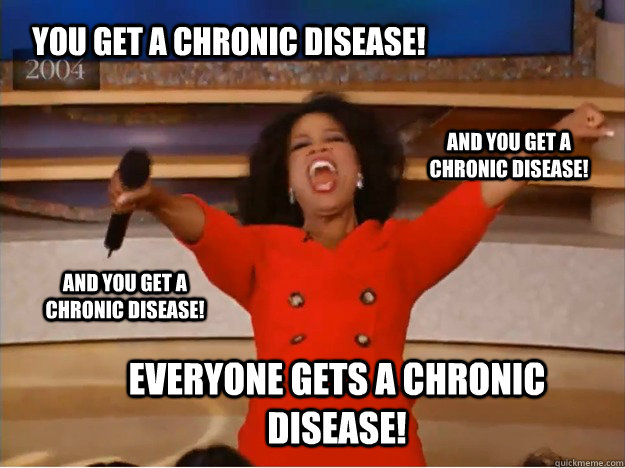
This prompt amused me, because when it comes to chronic diseases, they’ve never seemed to be an “either/or” proposition; rather, it seems like an “and” proposition. You have THIS chronic disease! And oh, also, you have THIS chronic disease! And THIS ONE TOO! You get a chronic disease, and you get a chronic disease, and if you look under your seat, EVERYONE in the audience gets a chronic disease!!


That’s why we have the term “co-morbidities,” because misery loves company.

In many ways, “choosing” a different chronic disease seems like minimizing someone’s pain; it’s almost mean. I know that if someone with another chronic illness said, “oh, I’d rather have Type 1 Diabetes; it seems easier than what I’ve got,” I might feel indignant and wounded. It’s that feeling when someone says, “at least you don’t have cancer.” I would never want to have cancer; it is an absolutely terrible scourge, and fuck it six ways from Sunday. However, the “at least” qualifier bothers me, because, again, it minimizes my condition’s impact on my life. I’ve written somewhat extensively on the cancer/diabetes dichotomy and why one is easier to receive sympathy and donations for; much of it has to do with, in my mind, the status of the chronic illness as an atypical, unpleasant and uninteresting progressive narration.

Cancer gives you a villain; it’s a life-or-death struggle, there are peaks, a climax, and the person is either hero or tragic victim at the end. Even with the idea of a possibly-ending remission, that’s just the set-up for the sequel; the “I Still Know What You Did Last Summer” villain popping up again.  Few chronic illnesses offer such a satisfying journey. This “cancer narrative,” while popular, is equally problematic for many people living with cancer, because it often casts them as victims when they don’t want to be. The concept that you “beat” or “lose” to cancer indicates a judgment on the person’s strength or strength of character; like a sport, a “loss” indicates that you just “didn’t want it enough,” which is maddeningly unfair and untrue.

That’s why I feel awkward and uncomfortable about choosing a disease instead of the one I have. My “grass is greener” is someone else’s “bête noir.”  However, if I had to pick, I would go for the one thing I have curiously never had: seasonal allergies (if that’s even considered a chronic illness).

My entire life, the one malady that has been curiously missing from my rap sheet is that of allergies. I am allergic to sulfa medication and nothing else. Twice, I have done a 60+-item scratch test at the dermatologist’s; twice, the only thing that has reacted has been the pure histamine control (so I really am skin reactive; I’m just allergic to nothing). Ironically, the one thing my skin is “allergic” to is being touched or scratched; I’m dermatographic (you can “write” on my skin and occasionally produce hives). So, just like everything else, my body isn’t rejecting outside stimuli; it’s rejecting myself, as usual. Stupid self-hate-filled body.

I realize that seasonal allergies can be a source of much consternation and misery (speaking to my cousin a few weekends ago confirms this). And I don’t want major food allergies; quite frankly, I’d rather be diabetic than be deathly allergic to some food that I had to avoid all restaurants for. But mild, recurring seasonal allergies that I can’t get rid of but goes away two weeks into spring? Sounds good to me.

This, of course, is cheating somewhat; I suppose an equal “chronic” illness should be something I have to deal with all the time, like what I have now. I guess it could be something that’s usually all right, but “flares” in nasty ways. But, I have to say, if it counts, give me a few weeks of seasonal allergies any year, over this. If seasonal allergies have a narrative, it’s that of a villain who comes back to make an impressive cameo over Sweeps Week, and then disappears for another year.

That, I could deal with.

-Ilana

Thursday, May 16, 2013

The Next Day: Diabetes Accomplishments, Big and Small

It's Day Four of Diabetes Blog Week! Today's topic is "Accomplishments, Big and Small"

We don’t always realize it, but each one of us had come a long way since diabetes first came into our life. It doesn’t matter if it’s been 5 weeks, 5 years or 50 years, you’ve done something outstanding diabetes-wise. So today let’s share the greatest accomplishment you've made in terms of dealing with your (or your loved one’s) diabetes. No accomplishment is too big or too small - think about self-acceptance, something you’ve mastered (pump / exercise / diet / etc.), making a tough care decision (finding a new endo or support group / choosing to use or not use a technology / etc.).

My greatest accomplishments have never been physical. They have been intellectual, emotional, artistic, social, but not physical. I have a certain degree of disdain for my body, as it seems to subvert my desires at every opportunity. The last time I remember being proud of a physical achievement is when I managed to speak on the phone without losing my breath while running more than 5 miles an hour on the elliptical. Mostly, my body seems a useless rag; something that’s never as thin or pretty or working as well as I want it to be.

Diabetes is a very physical disease, but there is a large portion of it that is mental, and the mental definitely affects the physical. I’ll never be a “physical” person, but the strides I’ve made with this condition mentally and emotionally have undoubtedly improved my physical well-being.

There’s a large movement out there that says, “don’t let diabetes define you,” and it’s one that I absolutely agree with. But there’s always the flip-side to this idea, which can be equally limiting and dangerous, and that’s trying to define yourself completely without diabetes; not letting diabetes be in your definition at all. That’s something I tried to do for a long time. It was an abject rejection of everything my body was trying to tell me.

My greatest accomplishment has been an acceptance of who I am. I may never accept my large bone structure and ribcage, but I can now talk about diabetes; not in the abstract, but as something that affects me, and something that I work on each day. I’ve entered into an incredibly supportive community. I never would have thought about blogging on this subject or sharing it with the world at large until I said, “this is who I am, and this is how I want to work to make my life better.” There are many, many people I can thank for this development, for encouraging me to get the pump and self-monitor and work to bring my A1cs down from the horrorshow of high school and college to the 8-9s of grad school to the 7s I’ve seen for the past 2.5 years. There are so many who deserve thanks for support. In the end, however, no matter how much encouragement or nagging I received, progress was all up to me and to the decisions I made. This is a lonely realization, but also an empowering one.

The problem with describing a “diabetes accomplishment” is that an accomplishment tends to describe one specific moment, frozen in time; it describes something you've done, that's over. That 7.1 A1c I achieved in February? I’m extremely proud of it. But to focus on it as an achievement can result in ignoring the work that still needs to be done. It’s not like the moment where I received my Master’s. That’s an achievement; it’s done, and it’s not going to go away (although receiving a degree never precludes further learning). My numbers, on the other hand, can and will change every minute. My health can be taken away from me at any time. It’s so, so important to recognize and celebrate the work that went into achieving these numbers and feeling good, but it’s important not to dwell on them as an impediment to forward motion.

Diabetes is scary, with its power to take your life away overnight. In a way, just waking up, having survived another day, is its own accomplishment. But it can’t just be about sheer physical survival; rather, it’s about living the best life possible. It’s the commitment to survival; the willingness to try, and try again, in the face of insurmountable odds, which is really what matters.

I woke up this morning, and I started anew, and I continued to take care of myself.

Every day, that is my diabetes accomplishment.


-Ilana
 

Wednesday, May 15, 2013

A Life Of Moments

Welcome to Day 3 of Diabetes Blog Week! Today's prompt: Memories.

Today we’re going to share our most memorable diabetes day. You can take this anywhere.... your or your loved one's diagnosis, a bad low, a bad high, a big success, any day that you’d like to share.

I have many memorable diabetes moments; so many that they almost blur together into a life. Most of them feature horrible highs or lows (for highs, see, for example, the Super Bowl party that ended with a crunch, here). When it comes to lows, there's the day an intensely low blood sugar coincided with my first migraine aura, and I thought I was having a stroke, because I couldn’t say the words that I was thinking (“peaches” became “pockets”). There was the one time in undergrad that I missed a test because I went low and fell asleep after treating, but it had a happy ending.

I wish I could remember more days where I was blissfully unaware of my diabetes because it didn’t act up in any way. Paradoxically, these “no-hitter” sorts of days aren’t memorable because I don’t have to think about diabetes screwing with my life, and that’s a good thing.

My diagnosis day was memorable: the return of an ominous phone call from the doctor’s office, the “you have diabetes, honey,” from my mom, the immediate transfer over to my best friend’s birthday party with barely any time to process; me, a twelve-year-old declining cake and ice cream because I thought I could never eat it again.

Diabetes provides me with many moments of anger.  There was this one that occurred about an hour ago, before I wrote this. I’m going to have at least three or four surgeries this year, all for things that have nothing to do with diabetes (I’d never had surgery before I broke my elbow in March).  I had an awesomely fast recovery from the first, so I could say, “screw you, diabetes, and your ‘slower recoveries’!” Today I consulted with the oral surgeon who will remove my wisdom teeth. I have accepted that they need to be removed, so I have no anger about that. The conversation I had with the nurse, however, made my blood boil:


Nurse: Are you a well-controlled diabetic?

Me: Yes.
Nurse: So you never have blood sugar swings?

Me: (smiling) Actually, there's not a Type 1 diabetic alive who doesn't see BG fluctuations.

Nurse: So you're saying you're NOT well controlled.

Me: No, I'm just saying that every person with diabetes has ups and downs because it's a complicated -

Nurse: So you do not have control over your diabetes.

Me: *livid pause* I'M WELL-CONTROLLED.


Seething in indignation, this is Ilana Lucas, reporting from the front lines of the misinformation war.

Other memorable moments, however, are happier ones. These often involve the Diabetes Online Community and the effect it has had on my life. I will probably write about this in more detail tomorrow, but there was the moment that I finally truly felt understood by a wider community, the moment I started a Twitter account that dealt with diabetes to connect with others, the moment where I just started talking about diabetes in my “regular life” Twitter account because I’d come to the realization that I wasn’t “Ilana” and “Ilana’s Diabetes” – they were both part of me. There were the D-Meetups, the first time I truly went and met people from the Internet, that have afforded me meetings and/or friendships with amazing people like Jamie and Larry and Kelly and many others.  There was the moment I decided to get a pump, and the moment my endo finally told me she was proud of me.

There were the moments where I achieved more than many might think possible, including my awards and degrees from two of the best universities on the planet, and my artistic and extracurricular pursuits. There was the moment when I stood in front of a class for the first time, knowing they were trusting me to be a professor and a role model, and all the highs and lows and surreptitious site changes in the classroom and the pump conspicuously buzzing in my underwear could not take that away from me.

There was the moment my partner, who has seen me through all the moments of sickness and health for the past almost nine years, told me he was ready for a lifetime of moments and asked me to marry him.
Good moment.

That means there’s a moment coming up next year that I desperately want to be memorable, but not because of diabetes: my wedding.

Diabetes has done so much to attempt to spoil my fun that I am terrified of what my wedding day will bring. So much planning and money and work, and the knowledge that it could still be a Bad Diabetes Moment sends chills down my spine. Yes, there are logistical details, too, like figuring out how to put a pump pocket in my dress, but the uncertainty that is there is the worst part. It’s like how some people worry about rain. Rain I can deal with; there’s an indoor ceremony space. There’s no way to run away from this.

A Sondheim lyric I am fond of quoting goes as follows: “Oh, if life were made of moments/Even now and then a bad one!/But if life were only moments/Then you’d never know you had one.” That lyric gives me hope. My wedding – whether my blood sugar is high or low – is one moment – one important moment, but still, just one moment –of a whole life; one with ups and downs, but overall one which I will be able to analyze outside of the moments, and one I intend to have well lived. I told the nurse that everyone with diabetes has ups and downs. That’s true of blood sugar, moments, and life in general. It’s true for everyone else, too.

So I’m looking forward to my wedding moment, but I’m also looking forward to the moments before and after. Because, if you zoom out a little, all those moments blur into a life.

-Ilana

Tuesday, May 14, 2013

We, the Undersigned... (Diabetes Petitions)

-->
On the second day of Diabetes Blog Week, our prompt is:

Recently various petitions have been circulating the Diabetes Online Community, so today let’s pretend to write our own. Tell us who you would write the petition to – a person, an organization, even an object (animate or inanimate) - get creative!! What are you trying to change and what have you experienced that makes you want this change?

I couldn’t choose just one; here are my petitions for the day. (Sing with me: "On the second day of D-Blog Week, my prompter gave to me: four D-petitions...") Feel free to sign!

Attn: Pancreas

We, the undersigned caregivers of a faulty pancreatic unit, believe that it is time you returned to work. You have used up your unemployment benefits, and we all know that, like real unemployment benefits, it’s not nearly enough to live on, or at very least you can’t maintain the same quality of life you had before, while you had your job. Unlike most on unemployment, you have a job ready and waiting for you. Most people on unemployment want to work and are just having a tough time. You are sullying their good name, as you just seem recalcitrant. 

Once you have returned to work, we demand the return, retroactively, of all the time lost and all the moments ruined by dealing with your bullshit. This includes, but is not limited to, time spent taking shots, putting in pump sites, calibrating basals, calculating boluses, carb counting, glucose testing, fasting and non-fasting blood tests and A1Cs, time spent in doctor’s offices, time spent worrying, thinking, sleep lost due to the terror of the number.

You will also be held liable for any complications caused due to your period of inaction.

Attn: BG Readings

We, the bleeding undersigned, insist that you behave consistently in response to consistent stimuli. It is patently unfair to display such erratic behaviour to those who have close dealings with you. This costs them a great deal of time and energy, something that could be avoided if you would merely behave in any sort of reliable, sane, or understandable fashion. Please follow some sort of natural or physical law, or enter rehab. The definition of insanity is doing the same thing and expecting different results. As this is your modus operandi, we petition to have you legally declared insane; we will not be responsible for any of your consequences.

Attn: Society and comedians at large
We, the weary undersigned, demand that you cease and desist using the term “diabetes” as a synonym to the terms “fat” “lazy” or “ugly”. This constitutes slander, or libel (depending on whether the words are spoken or written). As you can see, this is not a true estimation of the facts. Please, in the future, laugh at diabetes itself, not persons with diabetes. There is a difference. This is one of many differentiations that must be made.

The following obnoxious statements are to be discontinued, on punishment of
1) fine, and
2) showing the speaker’s day-to-day health and eating habits to the world at large for scrutiny:
  • “Someone ordered a burger and a diet Coke?! What an idiot!”
  • Someone “deserves” diabetes
  • “You must have eaten a lot of sugar as a kid”
  • “That show/cute animal photo/song is so saccharine, it just gave me diabetes”
  • “Diabetes” used as a monolithic entity. Type 1 and Type 2 must be differentiated, though the rule about shaming or jokes applies to both.  It’s like talking about “cancer.” Cancers share many similar characteristics, but having a mastectomy for lung cancer would be problematic.
  • “Can you eat that?” (The speaker will owe the wronged party a meal of his or her choice.)
  • “At least it’s not…”
  • “But it’s easy now that you have insulin/you’re cured now”
The phrase “just wait five years” will be punishable by a five-year jail term that extends for five more years at the end of the term, until the injured party is satisfied.

Special sanction for news providers:
Any facts about diabetes that are reported to the general public must be accurate and specific to the type of diabetes being mentioned. Dangerously inaccurate information may result in the website or reporter being charged with negligence.

Wilford Brimley references may be used, sparingly.

Attn: Diabetes Online Community
We, the grateful undersigned, petition you to continue to be open, giving and awesome. We insist that there be an official “DOC Day” to recognize your amazing ability to save and improve lives.

Signed,
Ilana

Monday, May 13, 2013

Understanding the Endo


Welcome to the official Diabetes Blog Week at Diaturgy! D-Blog Week, started by Karen at Bitter-Sweet Diabetes four years ago, was instrumental in getting this blog up and going, so I owe her a debt! It's also so much fun to participate in the community every year, all choosing the same topics.  Not content to leave well enough alone, however, I worked in a surprise; I kind of took today's prompt and turned it completely around.

Today's prompt: Often our health care team only sees us for about 15 minutes several times a year, and they might not have a sense of what our lives are really like. Today, let’s pretend our medical team is reading our blogs. What do you wish they could see about your and/or your loved one's daily life with diabetes? On the other hand, what do you hope they don't see?

Dear Endocrinologist:

This week is Diabetes Blog Week, and today’s assignment is for us to write a note to you telling you what we wish you’d understand about us in terms of the toll diabetes takes on our lives. It was perfectly timed, because I saw you today for the first time in six months. I was the first appointment of the day, and for once, I didn’t have to wait for an hour or more.  My numbers were both exciting and disappointing this time. Exciting, because the A1c I did in February was 7.1: a life-with-diabetes record. Disappointing, because thanks to breaking my elbow, pain medication, a stressful semester and no real time to exercise, I’m back up to 7.6. Endocrinologists often seem to go into “airport security” mode; with older data, they try to solve the problem that has already happened and been dealt with rather than the unseen problem ahead; my broken elbow is mostly likely the shoe bomber of incidents; stupid and scary and probably not happening again, but I guess I’ll take off my shoes at the office now.  I do wish you’d appreciate the utter unpredictability of my life and work a little more; I can’t just “take on fewer responsibilities” for my health; I take the schedule I’m given. When the office says, “so, Mondays are good to book six months from now?” That’s two semesters away, so damned if I know my schedule. It’s always going to be a crapshoot.

Here’s the thing, though. I’ve already written a “what you should know” post. It’s here. It’s comprehensive. I’m not interested in writing a version of it again.  I don’t want to draw a line in the sand and see you as an enemy, an impediment to my progress.

I feel lucky, in many ways. I feel like you do listen to me. You know I’m planning a wedding, and you asked how it was going, and whether I was stressed about it. You know what I’m up to in life and you seem genuinely concerned about my well-being. So I’m going to deviate from the assignment today, because today I’m going to try to understand you. For the first time, now that I’ve been a professor for two and a half years, I think I really can.

We had all of our difficulties when I was a teen, and into my early twenties. Some of the biggest issues were during my own college years. I felt you didn’t understand me, or my life. You said you couldn’t understand why I “couldn’t just do this,” a twisted rewrite of an awesome diabetes social media slogan. I felt like one of a zillion patients. You didn’t have time for me, to truly understand. You don’t know what it’s like. You don’t have diabetes. In a way, I was both happy and resentful when our relationship finally got better, clicked and soared; when I got the pump, when my numbers came down radically, when you felt I finally got serious about my health. Why only like me when I'm a "good" diabetic?

Replace “health” with “class,” though, and I could be one of my own students.

You see, I know what it’s like to have a demanding schedule, and to have 120 people whose progress I’m tasked with following over the course of a semester. I know how hard it is to sit and meet with everyone, to truly track progress; to give more than the most cursory comments about improvements to development, analysis, and grammar, because there’s NO TIME. If I met with each of my students for 15 minutes a week, that would be 30 hours with no breaks, let alone all the teaching and the prepping and the marking.  All of my comments, besides on drafts that nobody has time to write many of, can only deal with old data; how to fix a paper that's already been handed in for marks.

I know it’s loads more fun to work with a serious, passionate, excellent student who gets me and my subject; we talk, we fly and I don’t really have to do that much “work.” I know how much nicer it is to have a student who actually wants to improve. I know that I catch myself thinking, even with students who have English as a second language and horribly stressful home lives and illnesses and who deal with raising young children while being young themselves and are one step from poverty, “I don’t understand why you can’t just do this.” After all, I can do this. Look at all the studying I’ve done. Look at all the other people’s words I’ve learned and analyzed. Look at how good I am. I'm a model student, and I chose this course of study.

But you didn’t, my students. You didn’t choose this. English isn’t a major at my college. It’s a requirement. It’s difficult for many of my students; it’s not natural to their bodies. It’s not a first language, either literally, or metaphorically. Instead, it’s a hurdle they’ll have to deal with for the rest of their working lives. And, for me, in the end, it all comes down to the numbers: did they pass, or fail? I can only give so many marks for trying and working hard; in the end the work has to show, and measure up to an arbitrarily set standard. Many of their systemic language issues are such that I have no chance of fixing them in 15 short weeks, though I drill and drill.

I care about my students. I care deeply. I try my hardest to listen, to understand their lives and to make them easier. I know, however, that I need to be met halfway for true success, while I live in fear of failing someone who is truly in need. I’ve become a counselor for 17-year-olds, 30-year-olds, 60-year-olds whose life experience is beyond mine, whose problems I may never truly understand, but I know one thing, and that’s my subject. I know it as much as anyone. And I try to do my best with what I have and what my students give me. I’m only human, and I might flounder around a bit, but I’m doing my honest best.

In the world of teaching, I am you; I am my endo. But, while I have my students for a semester or two, and keep in touch with a few of them, you have stuck with me, through thick and thin, for the better part of a decade. You have seen me not care, and you have seen me come through the other side. Thank you.

So enough about you needing to understand me. Because, today, I needed to understand you. And I think I finally do.

-Ilana

Tuesday, May 15, 2012

One Great Thing


When I saw this blog topic, I got nervous. I couldn't think of something I did well enough to blog about. First of all, I don't want to brag or make anybody feel badly if I said I did something well and a reader feels he or she does not. But, really, I was stymied in coming up with something to say; writing skill or academic achievement doesn't really fit here.

Achievement has always seemed to come in spite of diabetes, not because of it. I had always considered myself a sub-par diabetic. I can't be perfect at diabetes, or even very good most of the time. Is that my fault, or is it diabetes' fault? It's probably a lot of the latter. I'm not used to getting praise for trying hard. I'm used to getting praise for being good at what I do, or not getting praise at all.

I've had a few excellent days with the range of my glucose results lately, however, including one day where none of my tests were above 8.5 or below 4.6. I attribute that to a sudden decrease in carbohydrates in my household, not necessarily to myself. I've just joined a gym, and I've gone and exercised almost every day since I did so, but maybe I could exercise more, or harder, even though I'm just getting re-started. I keep trying to frame this in a positive light about myself. It’s hard to do!

And then, I thought: but I *do* try. I try all the time. I'm good at trying with a condition that’s extremely trying. I made a decision to change the status quo, which was me taking a laissez-faire, backseat attitude to my diabetes, being okay with not testing often at all, using diabetes to lose weight, and I turned that around to the best of my ability. Okay, I don't test 20 times a day. I can't afford to. But I test four or five. I never miss a doctor's appointment, and I have many. I get my various parts checked as often as I'm supposed to. I take an active interest in keeping my pump settings current. I got involved. I could have happily stayed stuck in my rut, especially because I've gained weight since I started on the pump, and I hate that. But I took my A1c down from 9 to 7.3 in six months.

I'm not sure if I have "one great thing." I have room for improvement everywhere. But I made a change in my life, and I stuck to it. And at this point, I think that’s pretty great.

-Ilana